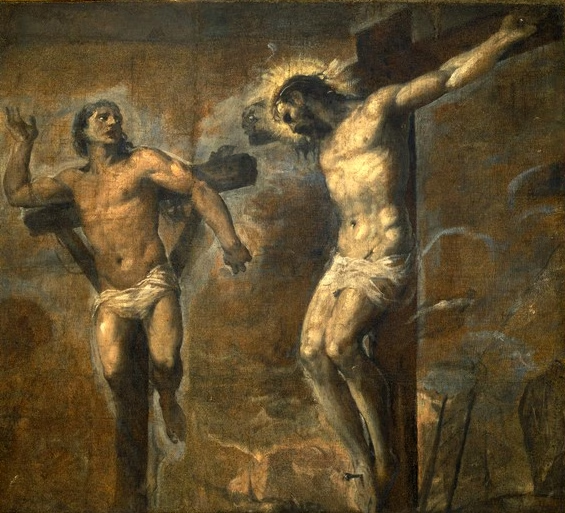
Let me ask you a question: Have you ever been punished for something you didn’t do? Maybe you have a sibling who framed you for something you didn’t do, and you couldn’t convince your parents of your innocence, and so you took the fall for it. Or maybe you deliberately took the fall for a sibling or friend in order to spare them the consequences of their actions or circumstances.
Those scenarios are not unlike what we find in Luke 23:26-43. Jesus has been brought up on false charges by his own people, the Jewish leaders, who then sought to put him to death. Israel was occupied by Rome at that time, so they couldn’t legally put him to death themselves. Instead, they made up charges based on half-truths or lies to try to get Rome to do their dirty work for them.
Pilate, the Roman governor, as well as Herod, a local ruler, both said they found no guilt in him (Luke 23:14-15). Yet, after continued pressure from the Jews, and likely fearing a riot or civil unrest, Pilate caves to pressure and sentences Jesus to death by crucifixion.
As Jesus hangs on the cross, crucified, Luke records how he is mocked three times in basically the same way by three groups of people. They all more or less say to him, “If you are who you say you are, save yourself.”
Jesus, being the Son of God, being the Christ, being God’s Chosen One, the King of Israel, certainly had the power to do just that—to save himself.
But he didn’t.
Let’s examine why he didn’t, and how a conversation he had with two criminals who were crucified alongside him serves as a picture of what our two possible responses to Jesus can look like.
Let’s read the passage first.
Luke 23:26-43
26 And as they led him away, they seized one Simon of Cyrene, who was coming in from the country, and laid on him the cross, to carry it behind Jesus. 27 And there followed him a great multitude of the people and of women who were mourning and lamenting for him. 28 But turning to them Jesus said, “Daughters of Jerusalem, do not weep for me, but weep for yourselves and for your children. 29 For behold, the days are coming when they will say, ‘Blessed are the barren and the wombs that never bore and the breasts that never nursed!’ 30 Then they will begin to say to the mountains, ‘Fall on us,’ and to the hills, ‘Cover us.’ 31 For if they do these things when the wood is green, what will happen when it is dry?”

32 Two others, who were criminals, were led away to be put to death with him. 33 And when they came to the place that is called The Skull, there they crucified him, and the criminals, one on his right and one on his left. 34 And Jesus said, “Father, forgive them, for they know not what they do.” And they cast lots to divide his garments. 35 And the people stood by, watching, but the rulers scoffed at him, saying, “He saved others; let him save himself, if he is the Christ of God, his Chosen One!” 36 The soldiers also mocked him, coming up and offering him sour wine 37 and saying, “If you are the King of the Jews, save yourself!” 38 There was also an inscription over him, “This is the King of the Jews.”

39 One of the criminals who were hanged railed at him, saying, “Are you not the Christ? Save yourself and us!” 40 But the other rebuked him, saying, “Do you not fear God, since you are under the same sentence of condemnation? 41 And we indeed justly, for we are receiving the due reward of our deeds; but this man has done nothing wrong.” 42 And he said, “Jesus, remember me when you come into your kingdom.” 43 And he said to him, “Truly, I say to you, today you will be with me in paradise.”
The Road to the Cross
In the ancient world, everyone knew crucifixion was the worst way to die. The Roman orator Cicero called crucifixion the “most extreme form of punishment” and a “most cruel and disgusting penalty.” The Jewish historian Josephus called it “the most wretched of deaths.” [1] It was designed not just to kill, but to humiliate and torture.
Prior to the act of crucifixion, the Romans would frequently flog and scourge the person who was going to be crucified, beating and bloodying them within an inch of their life. Sometimes, the person would actually die in that process, and they would just crucify the dead body.
For those who survived the pre-crucifixion process, the Romans forced them to carry their own cross to the site of their crucifixion (or at least the cross beam). If they were too weak to do that, then they would compel someone nearby to carry it for them. This is what we see in verse 26 with Simon of Cyrene.
During the crucifixion, people were nailed with long spikes to a cross or tied with ropes in various painful positions. They were sometimes seated on a small peg in order to prolong the punishment. Many hung on a cross for days, eventually dying from blood loss or suffocation. The crosses were put near public roads to be seen, and bodies were often left on the crosses to decompose as a public warning.
It was considered such a horrible way to die that Romans wouldn’t inflict it on their own citizens except in rare cases like treason. They even said that the word “cross” should be far from a citizen’s ears. It was a punishment mostly reserved for foreigners and slaves.
I tell you all this not to gross you out or anything, but to help you understand the gravity of the situation. From every human vantage point, Jesus had every reason to avoid crucifixion. And yet we still see him walking steadily towards it.
This information also helps us better understand the responses to Jesus that we see here in the passage.
A Warning to the Daughters of Jerusalem
Look again at verse 27.
27 And there followed him a great multitude of the people and of women who were mourning and lamenting for him.
These women were following him, devastated at what was happening to Jesus. But instead of receiving their sympathy, Jesus has something to say to them.
28 But turning to them Jesus said, “Daughters of Jerusalem, do not weep for me, but weep for yourselves and for your children.
That seems like a weird response. Why does he say that? Well, Verses 29-31 tell us.
29 For behold, the days are coming when they will say, ‘Blessed are the barren and the wombs that never bore and the breasts that never nursed!’ 30 Then they will begin to say to the mountains, ‘Fall on us,’ and to the hills, ‘Cover us.’ 31 For if they do these things when the wood is green, what will happen when it is dry?”
How’s that for an explanation? Clear as mud?
This part can feel pretty confusing—Jesus is walking to His own execution, and instead of receiving the women’s sympathy, He warns them about judgment, calling them Daughters of Jerusalem.
To understand what’s going on here, we have to know a little bit about the book of Luke as a whole. It’s easy to look at a passage like this and forget that Luke has already said some things about this subject.
Throughout the book of Luke, the city of Jerusalem has a special focus. Much of the book is written as one long journey to Jerusalem. In chapter 9, it says that Jesus “set his face to go to Jerusalem” (Luke 9:51), meaning he was determined to go there. Later, Jesus arrives at Jerusalem in chapter 19. When he looks at Jerusalem, he weeps over it, saying this:
“Would that you, even you, had known on this day the things that make for peace! But now they are hidden from your eyes. For the days will come upon you, when your enemies will set up a barricade around you and surround you and hem you in on every side and tear you down to the ground, you and your children within you. And they will not leave one stone upon another in you, because you did not know the time of your visitation.” (Luk 19:41-44)
Now, as Jesus is walking to his own death, he is again reminding them of their own coming judgment, basically saying to them: “If you think that what’s happening to me is bad, wait until you, your children, and all of Jerusalem come under judgment.”
We know from history that Jesus’ prediction was fulfilled in 70 A.D. when the Romans destroyed Jerusalem.
What this shows is that even as Jesus has been judged and is walking to be crucified, his heart is for others. He is warning them in hopes that they might repent and be saved.
Jesus’s Response to His Crucifixion
After this conversation with the women, Jesus continues towards his crucifixion.
32 Two others, who were criminals, were led away to be put to death with him. 33 And when they came to the place that is called The Skull, there they crucified him, and the criminals, one on his right and one on his left. 34 And Jesus said, “Father, forgive them, for they know not what they do.”
Just as Jesus has just pronounced judgment, now we also see him pronounce forgiveness. Despite the horrific nature of what’s happening to him, we see Jesus’ heart to offer mercy, even to those who are actively putting him to death.
These verses are also an important fulfilment of a prophecy from the Old Testament. In Isaiah 53:12, it says, “Therefore I will divide him a portion with the many, and he shall divide the spoil with the strong, because he poured out his soul to death and was numbered with the transgressors…”The “numbered with the transgressors” is fulfilled with him being crucified between the two criminals and being labelled guilty of a crime, though he was innocent. After that, Isaiah says, “yet he bore the sin of many, and makes intercession for the transgressors.”
Jesus’ prayer “Father, forgive them, for they know not what they do,” is him making intercession for the real transgressors as he, though innocent, bears the sins of many while being crucified.
This shows Jesus’ heart and the greater purpose behind why he is enduring all this: to make a way of forgiveness for those who would later believe in him.
4 Reactions to Christ
Having gone through all that, we finally arrive at the main section of this passage. We now encounter various reactions to Jesus: 3 negative, 1 positive.
Look with me again at the end of verse 34. And watch for a pattern in these 3 antagonistic statements toward Jesus.
And they cast lots to divide his garments. 35 And the people stood by, watching, but the rulers scoffed at him, saying, “He saved others; let him save himself, if he is the Christ of God, his Chosen One!” 36 The soldiers also mocked him, coming up and offering him sour wine 37 and saying, “If you are the King of the Jews, save yourself!” 38 There was also an inscription over him, “This is the King of the Jews.” 39 One of the criminals who were hanged railed at him, saying, “Are you not the Christ? Save yourself and us!”
So we have 3 different groups here:
- The rulers, who are the Jewish leaders;
- The Roman soldiers;
- One of the criminals being crucified next to Jesus.
And what do they all do?
- The rulers scoff.
- The soldiers mock.
- And the criminal rails against him, which means to hurl insults at him.
And what do they all say?
- “He saved others; let him save himself, if he is the Christ of God, his Chosen One!”
- “If you are the King of the Jews, save yourself!”
- “Are you not the Christ? Save yourself and us!”
In an ironic and insincere way, they all acknowledge the truth of who Jesus is: he is the Christ, God’s Chosen One, the King of the Jews. Though none of them believes it, they all declare the truth of Christ’s identity. Even the inscription or sign that is above Jesus’ cross, which was traditionally supposed to be where the criminal charges were written, even that inscription declares the truth of who he is: This is the King of the Jews.
These 3 groups all tell Jesus to do what they think the Christ should do, which is: “Save yourself,” or if you’re the criminal, “Save yourself and us.” Gotta slide that one in there just in case.
But Jesus defies all of their expectations. He doesn’t save himself, despite having the power to do so. Why?
Jesus didn’t save himself so that he could save others. Jesus didn’t save himself so that, by his death, he could save those who believe in him.
In order for there to be forgiveness of sins against a holy and righteous God, there needed to be a payment for that sin. And Jesus, being sinless and holy and innocent, was able to take upon himself our sin and die the death that we deserved so that, by believing in him and putting our faith and trust in him, we could have eternal life.
Interestingly, this is the message that we hear in the one positive response from the other criminal.
40 But the other rebuked him, saying, “Do you not fear God, since you are under the same sentence of condemnation? 41 And we indeed justly, for we are receiving the due reward of our deeds; but this man has done nothing wrong.” 42 And he said, “Jesus, remember me when you come into your kingdom.” 43 And he said to him, “Truly, I say to you, today you will be with me in paradise.”
The criminal acknowledges his sin, and he understands that he justly deserves to be put to death for his actions. And he also recognizes that Jesus is innocent and doesn’t deserve death.
At the same time, the criminal also acknowledges who Jesus is. When he says, “remember me when you come into your kingdom,” you don’t say that to someone unless you believe they are the Christ, the Messiah, a king.
Interestingly, in the gospels of Matthew and Mark, those gospels record that both of the criminals crucified with Jesus derided and reviled him (Matthew 27:44, Mark 15:32). But here in Luke, one of them is doing the exact opposite. And so it stands to reason that at some point while he’s hanging there, crucified, this criminal has a change of heart towards Jesus, declaring his innocence and asking Jesus to remember him in his eternal kingdom.
In response, Jesus says to him, “Truly, I say to you, today you will be with me in paradise.”
The Man on the Middle Cross
So, all of this raises a question: On what basis was this criminal saved?
A few of you may know of a pastor out in Cleveland named Alistair Begg. In this clip below, Alistair tries to describe the rather comedic scenario of what the conversation might have been when this criminal arrived in heaven the day he died.
Eventually, after not knowing how to answer multiple points of theology asked by the angels, he was asked, “On what basis are you here in heaven?” The criminal can only respond, “The man on the middle cross said I can come. Jesus said I could come.”
If you were to be asked that same question, how would you answer?
As Alistair said in that video, if we answer that question in the first person (“Because I … Because I believe … Because I have faith … Because I am this … Because I have done this or that…”)—if we answer that way, then we’ve missed the mark. The only proper answer is in the third person: “Because he … Because he died to save sinners like me … Because the man on the middle cross said I could come.”
This criminal went to paradise, yet he hadn’t been baptized, he hadn’t been to a Bible study, he wasn’t a member of a church, and he hadn’t done anything good or noteworthy in his life to be recognized for. He had no opportunity to earn or merit God’s favor. All he could do was say, “Jesus, remember me when you come into your kingdom.”
So, on what basis did he inherit salvation? Because Jesus, the man on the middle cross, said he could come. Because of an act of sovereign grace by the Lord.
So, on what basis can we inherit salvation? The same thing. It’s not because of anything that we’ve done. It’s because Jesus said we could come. He gave his life in place of mine. He became that ransom, a sacrificial lamb, the payment for the penalty of my sins that I deserved, of our sins so that we could have eternal life with him.
We can inherit salvation because, when Jesus was told repeatedly to save himself, he didn’t.
Application – 2 Responses to Jesus
So, where does this leave us? What should our response to this be? These two criminals in this passage give us a very clear picture of what our possible responses to Jesus could look like.
For Non-Christians
So let me start by addressing those of you who aren’t Christians. To the non-Christian, thank you for reading this and making it this far. If you aren’t too familiar with Christianity, my guess is that all of this could feel pretty overwhelming. The crucifixion of Christ is one of the heaviest topics to talk about because it most clearly portrays the depravity of sin and the human heart—including mine, including yours, including every person’s heart.
All of us stand as criminals before God because of sin. Every person, apart from Jesus, would stand condemned, deserving death, and justly so.
Now, depending on where you’re at, it might be difficult to see yourself as a criminal at all, let alone the criminal who rejected Jesus. But I hope to help you understand: regardless of what you believe, apart from the salvation that Christ offers, that is the reality of where you stand before God. I don’t tell you this to heap any condemnation upon you. I tell you this because I love you and want you to know the truth.
It doesn’t matter whether you’re a good person, whether you do any good deeds, even if you like Jesus as a good teacher, the Bible tells us that all—every single one of us—have sinned and fall short of the glory of God. And that only by trusting in Jesus and who he is and what he did on that middle cross, can anyone be saved.
The best news I can give you tonight is that this invitation is open to everyone. No matter what you’ve done, no matter who you are, Jesus invites you to enter into that relationship of trust with him and to put your faith in him and receive the grace and mercy that God offers through Christ’s sacrifice on the cross.
For Christians
For those in this room who are Christians, I want you to understand that you are just like the criminal who turned to Jesus and believed in him. Both criminals started on the exact same playing field, mocking Jesus, opposed to him. Similarly, all of us were born in sin, and it’s only because of what Jesus has done that we can put our faith and trust in him.
This is all the more reason that we need to preach the gospel to ourselves and remind ourselves of these fundamental truths. Because a temptation for any Christian is to wind up in a place where you are living as if your salvation depends on you—to put our trust in ourselves, to put our trust in our experience and what we feel. And as Alistair Begg says, as soon as you go there, you will fall into an abject despair born of your own shortcomings or a horrible kind of arrogance born of pride. I’ve seen many people fall into both of those pits.
Though it’s easy to look at a passage and say, “Yeah, I already know this,” understand that you will never outgrow these foundational truths. So take heed of these things.
But also, I would encourage you to rejoice in the grace that you have received through Christ. A passage like this can leave you feeling heavy, and maybe there’s something in that which you need to pray about with God, confess to a friend, or talk to with a mentor. At the same time, understand that Scripture reminds us that there is no condemnation for those who are in Christ Jesus.
Though we stood condemned as criminals, the man on the middle cross said that we would be with him in paradise. That man, Jesus, chose not to save himself and died a criminal’s death in our place, so that we might be able to enjoy eternal life with him. And in that, we can take comfort and joy.
[1] Gerald G. O’Collins, “Crucifixion,” in The Anchor Yale Bible Dictionary, ed. David Noel Freedman (New York: Doubleday, 1992), 1207.